
Residential Garage Door Spring Repair in Baltimore for doors that won't lift, travel crookedly, or have visibly broken spring coils
A loud bang from the garage followed by a door that refuses to move is almost always a snapped torsion spring—one of the most common mechanical failures in residential garage door systems. New Look Garage Doors LLC handles residential spring repair throughout Baltimore, replacing failed springs and doing the full balance and cable check that makes the difference between a repair that holds and one that creates another failure within months. The attached and detached garages common across Baltimore's rowhouse blocks and postwar single-family neighborhoods rely on torsion spring systems that take thousands of cycles of load before a break, but when that break happens, the door becomes too heavy for the opener or a person to safely move.
The process at New Look Garage Doors LLC goes beyond swapping the broken spring. After the new spring is installed and tensioned, the technician adjusts and balances the full track and cable system so the door travels evenly from open to closed. This matters because a spring replacement that doesn't include cable and drum inspection can leave a door that lifts crookedly, binds on one side, or places uneven load on the new spring—shortening its lifespan significantly. Heavy-duty replacement springs are selected for daily-use durability appropriate to the door's weight and cycle demands.
Request an on-site evaluation to assess your spring condition and identify whether additional cable or track adjustments are needed before a failure occurs..
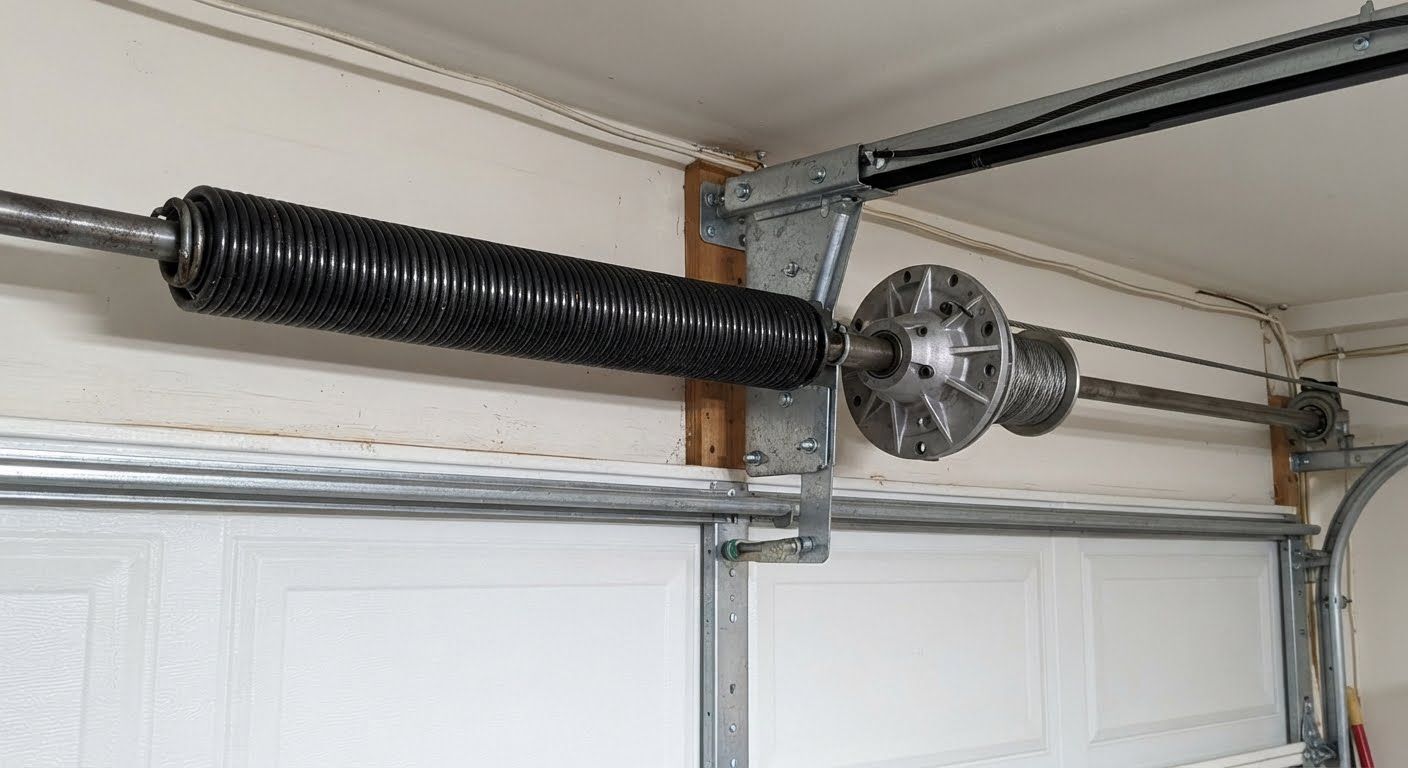
What Proper Spring Replacement Requires
Spring replacement on a residential door begins with releasing any remaining tension safely from the broken or worn spring before removal—this step requires the correct winding bars and cannot be safely shortcut. Once the old spring is off, the technician measures the wire diameter, inside diameter, and length to select a replacement with the correct specifications for the door's weight. Installing an undersized spring on a heavier door is a frequent source of premature failures that homeowners never trace back to the original repair.
After the new spring is wound to the correct tension and the hardware is secured, the door is disconnected from the opener and tested for manual balance—a properly tensioned door should hold steady at the halfway point with no drift up or down. Once balance is confirmed, the cables are inspected for fraying at the drum attachment point, the drums are checked for even winding, and the full travel is tested under opener power. You'll notice the door moves smoothly without hesitation at the start of the lift, tracks straight without pulling to one side, and requires no unusual force to operate manually.
Torsion springs are rated by cycle count, and the replacement selected should match or exceed the cycle rating appropriate for how frequently the door is used—a household that operates the door four or more times daily will exhaust a lower-cycle spring significantly faster than the rating suggests under average-use assumptions..
What Homeowners Ask About Spring Repair
The questions below address how residential spring repair is performed, what the process involves, and what to look for once the work is complete.
- How do you know a spring is broken rather than another component? A snapped torsion spring produces a sharp bang audible from inside the house, and you'll see a visible gap in the coil when you look at the spring bar above the door—a spring under correct tension has continuous, evenly spaced coils with no separation.
- Why does the door feel so heavy after a spring breaks? The torsion spring carries the counterbalance load equal to the door's weight, so when it snaps, the opener motor or manual effort must move the full unassisted weight of the door panels, which on a standard two-car residential door often exceeds 200 pounds.
- What other components get checked during a spring replacement? The technician inspects the cables at both drum attachment points for fraying, checks the drums for even cable winding, examines the track brackets for looseness, and verifies the opener's force settings are appropriate for the newly balanced door—a recalibration the opener often needs after a spring swap.
- How does the condition of Baltimore's older rowhouse garage setups affect spring repair? Many rowhouse garages in neighborhoods like Hampden and Charles Village have narrower openings with single-spring torsion setups and older track hardware—the technician accounts for clearance constraints when selecting spring length and checks older cable drums for wear that may not be visible on newer systems.
- What should you check after a spring replacement to confirm the work is complete? Disconnect the opener and lift the door manually to about halfway—it should stay in place without drifting up or dropping. Then reconnect the opener and run several full cycles, watching for any side-to-side lean during travel, which indicates a cable tension imbalance that needs correction.
New Look Garage Doors LLC also performs residential garage door spring repair in Rockville, Silver Spring, and surrounding DMV communities. To schedule an evaluation of your spring system before a failure grounds your door completely, connect with New Look Garage Doors LLC to arrange a visit at your convenience.